

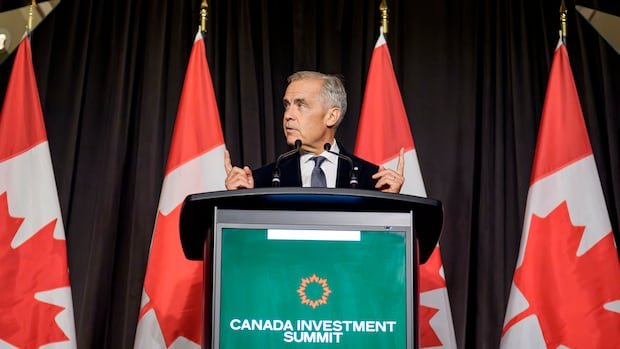

The inaugural Canada Investment Summit has attracted numerous wealthy investors to Toronto. The event, commencing with a reception on Sunday, seeks to facilitate connections between global investors and Canadian business leaders to spur investments totaling $1 trillion nationwide over the next five years.
Former central banker and Brookfield Asset Management head, Prime Minister Mark Carney, is familiar with prominent investors. The ongoing Canada-U.S. trade conflict has heightened the urgency to establish new partnerships and demonstrate Canada’s attractiveness for investments.
The guest list for the summit remains undisclosed, but notable figures such as Larry Fink of BlackRock Inc. and Dilhan Pillay of Temasek are reportedly in attendance. Sovereign wealth fund managers, including those from Norway and the Abu Dhabi National Oil Co., are also expected. The summit anticipates participation from various banks and fund managers from Canada and globally.
The reception on Sunday gathered top executives from Canadian companies like Air Canada, Cohere, Enbridge, and Alto, the latter planning a high-speed rail link between Toronto and Quebec City. Several Canadian politicians, including premiers, also participated.
The summit showcases 167 projects, encompassing various sectors such as conventional and clean energy, mining, marine infrastructure, digital technology, and transportation. Energy and mining projects dominate, reflecting government priorities. Noteworthy ventures include the $35 billion Alberta-B.C. pipeline, a $79 billion expansion of the Port of Churchill, and the proposed $28.5 billion Ksi Lisims LNG terminal in B.C.
The primary objective is to position Canada as an appealing investment hub, addressing past concerns regarding project approval timelines. A recent report by the CPP Investment Insights Institute highlights Canada’s stability and predictability but emphasizes regulatory complexities and lengthy permitting processes as deterrents for investors.
To enhance competitiveness and signaling seriousness in large-scale initiatives, hosting such summits is crucial. If managed effectively, a predicted investment “supercycle” could significantly benefit Canada’s economy, generating substantial job opportunities and boosting GDP.
While foreign investments offer significant growth potential, concerns persist about potential loss of control over Canadian projects. Critics, including Federal NDP Leader Avi Lewis, view the summit as a means to surrender national interests. However, proponents argue that foreign investments can be managed to uphold Canadian sovereignty, emphasizing the need for transparency in agreements to address public skepticism.