

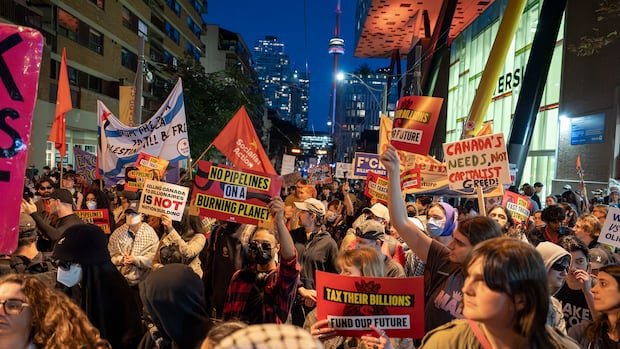

More than 1,000 protesters gathered in downtown Toronto on Monday to demonstrate against an investment summit led by Prime Minister Mark Carney. Toronto police confirmed that two individuals were arrested during the protest.
The Canada Investment Summit, scheduled for Monday and Tuesday in Toronto, is organized by Carney to attract over 100 of the world’s largest investors to potentially secure $1 trillion in investments for 167 projects across Canada in the next five years. The prime minister aims to portray Canada as a secure and dependable investment destination amid economic uncertainties, although some skeptics doubt the benefits of foreign investments for ordinary Canadians.
Rachel Small, a representative from World Beyond War, emphasized the need for increased investments in education, transportation, and healthcare to address the financial challenges faced by Canadians. She criticized Carney’s approach, claiming that selling public resources without guaranteed returns and promoting industries that may escalate global conflict and environmental crises is counterproductive.
The diverse group of protesters, including labor union members, Indigenous leaders, and environmental advocates, expressed concerns over relinquishing Canada’s economic future to corporate executives and raised apprehensions about the impact on public services, pipelines, and arms manufacturing.
The demonstrators congregated initially at Nathan Phillips Square and then marched towards the Art Gallery of Ontario (AGO), where the summit’s closed-door opening gala was being held. Approximately 200 to 300 Toronto police officers were stationed near the AGO to prevent any breach of security.
Two women were arrested for obstructing a road near the AGO, with one being charged for defying police instructions and the other for assaulting an officer during the arrest. The protesters, rallying under the theme “The Many vs. The Money,” voiced their opposition to the perceived auctioning off of Canadian public assets at the summit.
Key concerns highlighted by speakers at the protest included worries about investments in artificial intelligence, military activities, and fossil fuels. Indigenous activist Kakeka ThunderSky criticized the expedited environmental assessments and governmental policies affecting First Nations’ territories.
Federal Industry Minister Mélanie Joly defended the summit, assuring that national interests, including security, would not be compromised. She emphasized the necessity of foreign capital to support Canada’s economic growth and infrastructure development.
Moreover, concerns over foreign investment were underscored by expert Jeff Mahon, who stressed the importance of reviewing investments for their net benefits and impact on job creation and economic competitiveness under the Investment Canada Act.
The protest signifies a growing opposition to the summit’s objectives, reflecting the ongoing debate surrounding the potential implications of large-scale foreign investments in Canada’s economic landscape.