

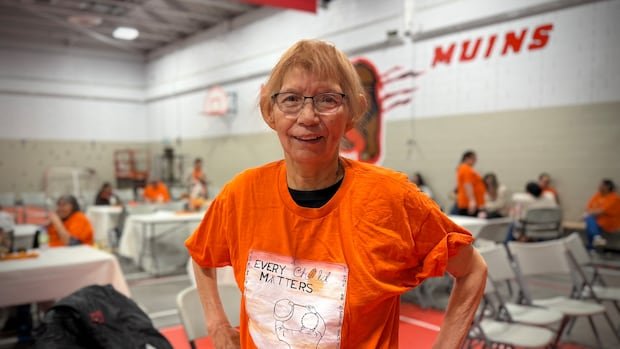

Margaret Labobe, a survivor of the Shubenacadie Residential School in Nova Scotia, recollects her distressing time at the school, where she and her siblings were separated from their parents on P.E.I. She vividly remembers the oppressive environment that prohibited the use of the Mi’kmaw language and imposed strict control over personal appearance and belongings.
Despite expecting kindness from the nuns, Labobe found them to be harsh and unsympathetic. She recalls the uniformity enforced through short, permed haircuts and the marking of children’s belongings with identification numbers – hers was number nine, coinciding with her Nov. 9 birthday.
Now residing in Lennox Island First Nation, Labobe is among the few remaining residential school survivors in the community. With the dwindling number of survivors, Chief Tabatha Bernard expresses concern about losing the firsthand accounts and experiences of those who endured residential schools.
In an effort to preserve these stories, Lennox Island recently held an Orange Shirt Day ceremony, where students engaged in cultural activities and interacted with the survivors. Labobe, a regular attendee at the event, finds solace in observing the children and aims to prevent them from enduring similar hardships.
She relishes witnessing the younger generation embracing the Mi’kmaw language, a freedom she was denied during her time at the residential school. Labobe is actively relearning the language with the hope of engaging in conversations with community children.
Labobe has also dedicated time to visiting schools across the province to educate students about her experiences at the residential school. As the number of survivors diminishes, she emphasizes the importance of passing down these narratives to future generations.
During the recent ceremony, younger community members symbolically wrapped Labobe and other survivors in blankets, offering them comfort and support. Labobe, touched by the gesture, reflects on the care she never expected to receive after her challenging upbringing.
Despite the diminishing survivor count, Labobe remains optimistic about the continuity of these stories through the younger generations. She acknowledges the role of descendants in carrying forward the legacies and lessons of residential school survivors.