

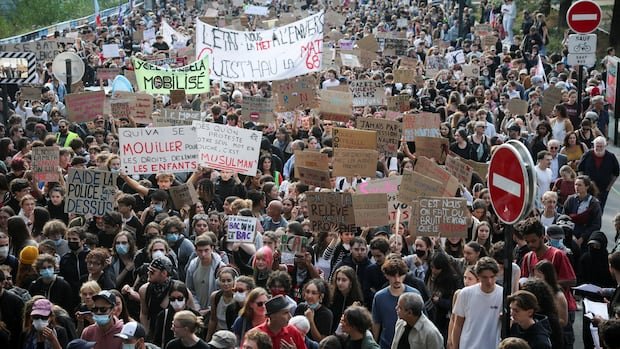

Students, educators, and guardians took to the streets in various French cities on Tuesday, with demonstrators also blocking hundreds of schools as part of a significant day of action in a series of protests demanding government action to address overcrowded and rundown classrooms.
In Marseille, Nantes, and Lyon, the demonstrations kicked off peacefully in the mid-morning, with the largest gathering anticipated in Paris later in the day. Demonstrators carried smoke flares and signs expressing frustration such as “Anger under our textbooks” and “Do politicians even acknowledge our existence?”
These demonstrations on Tuesday followed two weeks of protests that originated in the impoverished suburbs of Paris before spreading nationwide. The government responded by deploying riot police, citing a shift in the movement towards urban violence.
In a recent incident, a teenager lost his hand during clashes between high school protesters and riot police in northern France. The local prefect refrained from providing specific details but mentioned that a group of protesters had been hurling objects at law enforcement.
According to a regional newspaper, the 15-year-old suffered severe injuries after handling a police dispersal grenade. The High School Students Union reported that around 1,800 high schools were either blockaded or closed for the day, while some educational authorities attempted to transition to online classes.
Prime Minister Sébastien Lecornu instructed his ministers to address key demands from the students, including the replacement of absent teachers, reassessment of the school day duration, and the necessity for longer breaks. The government is also looking into renovating aging school facilities, with proposals due by the end of October.
However, securing funding for these initiatives may pose a challenge. The protests have placed significant pressure on the government, coinciding with efforts to reduce a growing budget deficit amidst concerns from investors about France’s escalating debt, sluggish economic growth, and reluctance to curb expenditures.
The unrest in France has started to impact borrowing costs, extending to the broader eurozone. Despite this, the Finance Minister stated that intervention by the European Central Bank was unnecessary. Meanwhile, as the bond market crisis deepens, Marine Le Pen, the far-right populist leading the presidential race, outlined plans to slash public expenditure if elected.
The Interior Ministry reported over 6,100 arrests since the onset of the protests, with the majority being minors. Violent clashes have resulted in injuries to both police officers and teenagers. With an upcoming election to replace President Macron, accusations have emerged that hard-left lawmakers and mayors are fueling the protests, a claim vehemently denied by the accused party.
The unrest has drawn attention to the challenging socio-economic landscape in France, with conflicting perspectives on the role of local authorities and the need for governmental reforms to address the grievances of students and educators.