

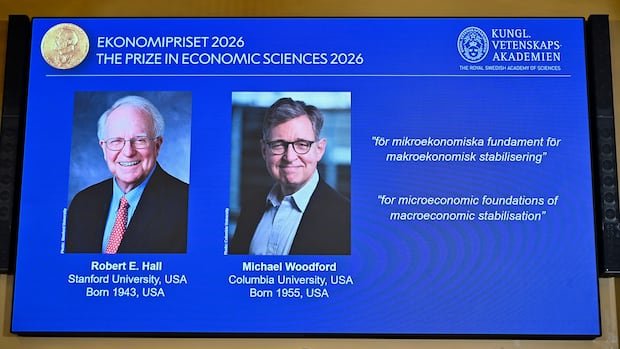

American economists Robert E. Hall and Michael Woodford, both born in the U.S., were awarded the Nobel Memorial Prize in Economics on Monday for their research on models that have aided governments and central banks in navigating economic shocks. The Royal Swedish Academy of Sciences disclosed the laureates in Stockholm, commending them for their contributions in assisting policymakers in handling economic fluctuations.
Stanford University in California is where Hall is associated, while Woodford is linked with Columbia University in New York. Woodford expressed his surprise and honor during a phone call with the committee from New York, stating, “It’s a tremendous honor.”
According to John Hassler, the chair of the Committee for the Prize in Economic Sciences, the laureates’ work has laid a stable theoretical groundwork for the models currently utilized by central banks and governments worldwide. The new foundation for stabilization policy has equipped policymakers to better manage economic shocks such as energy crises and abrupt shifts in consumer spending.
In the past, governments responded to economic shocks by implementing the Keynesian approach of tax reductions and increased government spending to stimulate consumption and investment. However, this strategy proved inadequate during the stagflation of the 1970s, prompting Hall and Woodford to develop an enhanced model considering how consumers and businesses make financial decisions.
Hassler emphasized that the contributions of Robert E. Hall and Michael Woodford have significantly advanced the understanding of stabilization policy. The Nobel Memorial Prize in Economics, established by the central bank in 1968 in memory of Alfred Nobel, is technically separate from the Nobel Prizes but is traditionally awarded alongside them on Dec. 10. The prize money this year amounts to 12 million Swedish kronor (approximately $1.7 million Cdn) for an individual, a small group, or an organization.