

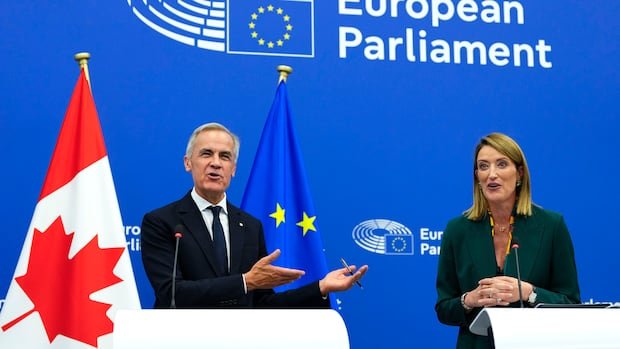

Canada is showing a keen interest in becoming an associate member of the Erasmus+ program, a renowned European exchange initiative, as ties between Canada and the EU strengthen. Prime Minister Mark Carney emphasized the potential benefits of Canadian participation in Erasmus+ during his speech at the European Parliament in Strasbourg, France. Carney underscored the advantages for students from both regions to study at top universities worldwide, broaden their horizons, and forge lasting connections.
Although specific details of this proposed partnership, including the implications of being the EU’s first associate member, are yet to be finalized, Carney clarified that Canada is not pursuing full EU membership and would require a distinct framework for this potential collaboration. Additionally, Carney expressed interest in Canada’s involvement in Horizon, Europe’s research and innovation funding program, for the upcoming phase.
European Parliament President Roberta Metsola echoed Carney’s sentiments, highlighting the significance of Erasmus in the minds of young people in the EU and the potential for expanded opportunities with allies like Canada. The exchange program, initially established as Erasmus in 1987, allows individuals to study and train across European institutions for periods up to a year. It has evolved to encompass various exchange opportunities beyond traditional university programs, including work experience, apprenticeships, and sports exchanges.
With over 16 million participants since its inception, the Erasmus+ program has been a cornerstone of educational and cultural exchange in Europe. The program received substantial funding from the EU, with the current budget for 2021-2027 estimated at approximately €28.5 billion, prioritizing learning mobility and supporting co-operation projects and policy development activities. Erasmus+ encompasses all EU member states and several other countries outside the EU, including Canada’s potential future involvement as an associate member.
The recent example of the UK’s temporary agreement to join Erasmus+ could serve as a roadmap for Canada’s potential participation, despite not being an EU member. The UK’s one-year deal involves a significant financial contribution to the program, indicating the potential financial implications for Canada’s involvement in Erasmus+ in the future.