

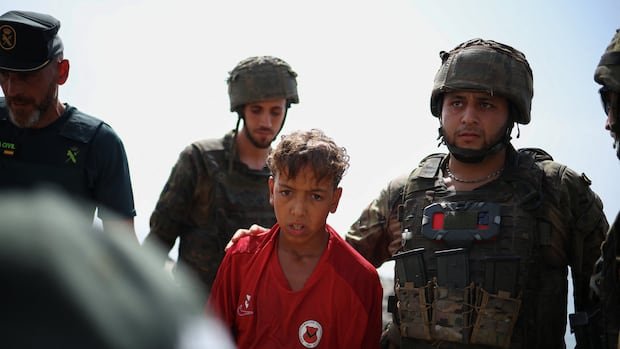

In Ceuta, a small Spanish territory in North Africa, more than 72,000 individuals crossed from Morocco last week by swimming around the border, creating a situation where asylum seekers now await their next steps.
This week, numerous individuals were observed resting on a small beach on the outskirts of town as the enclave’s limited shelters were already occupied, mainly by women and children. Aid organizations, which were initially scarce when exhausted swimmers first arrived, are now providing food and water to those who were not sent back to Morocco due to an agreement designating Morocco as a safe third country.
While humanitarian groups address the aftermath on the ground, the discussion across Europe has mainly focused on preventing another large-scale crossing. European lawmakers deliberated the Ceuta crossings and migration policy in Brussels on Wednesday following a significant political dispute within the bloc triggered by last week’s events.
Shortly after the crossings, EU member states hurriedly pointed fingers at Spain, attributing the migrant attempts to decisions made by Prime Minister Pedro Sánchez’s government. Italy temporarily suspended passport-free Schengen travel arrangements with Spain, and 22 EU member states called for enhanced external border controls.
European Commission President Ursula Von der Leyen deemed the crossings “unacceptable,” and German Chancellor Friedrich Merz urged Morocco to “take back illegal migrants immediately.” Despite a shift in rhetoric at Wednesday’s meeting in solidarity with Spain, concerns persist.
The responses to the Ceuta situation highlight not only disagreements over migration policy but also domestic political considerations. Politicians have characterized the crossing as an “invasion,” emphasizing security threats over humanitarian crises.
Spain’s approach to migration diverges from that of many European counterparts, with a recent program regularizing the status of 500,000 undocumented migrants. Misinformation, confusion over legal procedures, and Morocco’s border enforcement have been cited as factors behind the mass crossing attempt.
European leaders are now prioritizing border reinforcement over addressing the needs of thousands of asylum seekers awaiting legal guidance, shelter, or asylum status. Notably, roughly 1,100 unaccompanied minors remain in Ceuta, underscoring the ongoing challenges faced by those stranded in the aftermath of the border surge.