

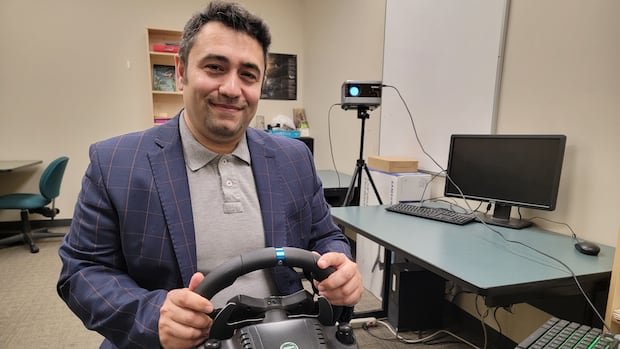

A researcher from the University of Northern British Columbia is investigating driving patterns to enhance wildfire evacuation plans in the future. Alireza Noory, a UNBC PhD candidate, has created a driving simulator to assist emergency planners in northern regions in understanding driver reactions during wildfire evacuations.
The decisions made by drivers in the face of a wildfire threat can significantly impact the speed at which individuals reach safety. The simulator involves participants driving on Highway 97 north of Prince George under normal conditions and then in a wildfire evacuation simulation. Various factors such as reaction time, speed, acceleration, braking, and lane positioning will be analyzed during both scenarios.
Noory stated that utilizing behavior data from local drivers can lead to more accurate evacuation predictions and aid local agencies in devising safer and more efficient evacuation strategies. He emphasized that current evacuation models often rely on broad assumptions or data from different communities, making locally sourced data crucial.
The collected data will be utilized to fine-tune a computerized traffic model of Prince George, potentially helping city officials anticipate traffic flow during evacuations. This calibrated model can predict evacuation travel time, congestion, road closures, and alternative traffic management strategies pre-evacuation.
Observations from the study reveal that some drivers intentionally reduce their speeds during high-stress situations, which was an intriguing discovery for the researchers. The driving simulation aims to understand how drivers adjust their behavior when faced with reduced visibility, urgency, emergency alerts, and wildfire-related risks.
In emergency situations, most evacuations occur via roads and highways using personal vehicles or public/private transit, according to the province’s evacuation procedures for Indigenous and local governments. Areas with limited exit routes are advised to consider alternative transportation methods like air, rail, and marine transport.
Communities are urged to plan for the number and distribution of evacuees, assess transportation infrastructure capacity, anticipate congestion, and plan for contingencies like fuel supplies and vehicle breakdowns. Mayor Surinderpal Rathor of Williams Lake stressed the importance of having various tools available for emergency scenarios, drawing from the chaos and frustration experienced during a community-wide evacuation in 2017.
The study findings are anticipated to benefit newcomers to the community by providing insights on how to navigate high-stress evacuation situations effectively. Researchers are seeking adult drivers of different ages and experience levels to participate in the project.
The study seeks to contribute valuable data to enhance wildfire evacuation planning and improve overall community preparedness for future emergency scenarios.