

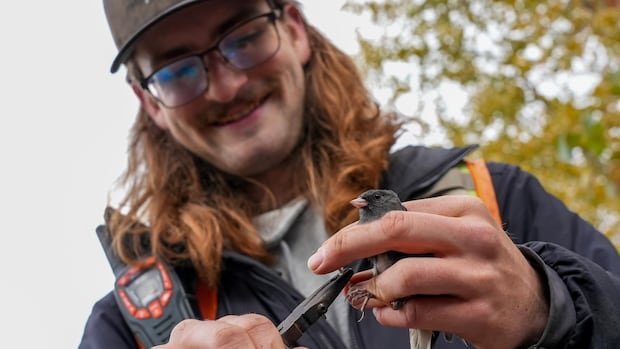

In the midst of the boreal forest, Ethan Denton, a Calgary-based ornithologist temporarily stationed in Fort McMurray, Alberta, stands by a network of nets and carefully retrieves a dark-eyed junco, a small grey songbird, from a cloth bag. Denton then uses pliers to affix a lightweight aluminum band with a unique identification number onto the junco’s right leg before documenting its gender and measurements. This data collection aids researchers continent-wide in tracking the bird’s migration routes.
Ken Foster, a co-founder of the Wood Buffalo Wildlife Research Institute (WBWRI), observes Denton’s work and explains the institute’s mission to volunteers. WBWRI, a unique non-profit organization in Fort McMurray, focuses on conducting ongoing bird monitoring projects in the oilsands area.
Foster emphasizes the importance of understanding bird population trends, stating, “We all sense birds are declining. Programs like this define which birds are declining, by how much, and hopefully, what we can do to help reverse it.”
Although bird studies in the oilsands region are not new, WBWRI aims to provide long-term stability in research efforts. Foster, along with his wife Christine Godwin, established the non-profit in 2024 to continue their ecological work and involve volunteers in wildlife research initiatives.
Through data gathered by Owl Moon Environmental Inc. (OMEI), Foster notes varying responses among bird species to environmental changes in the oilsands region. Some species like the least flycatcher and northern waterthrush have seen population declines of up to 90% over the past 15 years due to habitat alterations from wildfires and industrial activities disrupting their migration routes.
Conversely, generalist species such as clay-colored sparrows are thriving in disturbed habitats, benefiting from reclaimed oilsands sites and regrown forest areas. Foster highlights the support received from energy companies for his research endeavors, emphasizing the need for outreach and education efforts through WBWRI projects.
WBWRI’s initiatives extend beyond bird banding, including the implementation of an automated tracking tower to monitor animals with radio transmitters. The organization also plans to assess bat populations’ health and train volunteers in wildlife rehabilitation in the Fort McMurray region.
Foster underscores the significance of programs like WBWRI in quantifying environmental changes, stating, “We all sense fewer birds.” The institute’s holistic approach aims to address declining bird populations and promote conservation awareness through community involvement and scientific research.