


Along a dusty road in remote Saskatchewan, a farm complex featuring two residences, a vibrant red barn, a workshop, a communal dining area, and a greenhouse is lively with activity.
Individuals with cognitive challenges are engaged in gardening tasks on a sunny August day. While some women are harvesting beans, a small group of men is tending to the corn and potato crops.
Resident Lynne Cammidge, aged 52, feels content at Farm in the Dell. “I find it incredibly serene. When I first arrived here, I was amazed by the farm’s beauty,” she shared.
Cammidge was among the initial occupants to transition to this rural group home fifteen years ago. “My parents were aging, and they wanted me to relocate here. I explored a group home in Saskatoon, but it didn’t suit me,” she explained.
Farm in the Dell, a non-profit organization, offers enriching employment opportunities and a countryside lifestyle for individuals with cognitive disabilities. Situated approximately 45 kilometers northeast of Saskatoon near Aberdeen, Sask., the farm aims to provide a fulfilling experience.
“It entails a lot of effort, yet the individuals are highly proficient in tasks like weeding, watering, and maintaining their living environment. They take immense pride in their work,” remarked Shauna Dollansky, the site manager in Aberdeen.
Many residents have roots in farming or rural settings and seek to continue that connection as adults. “It instills a sense of purpose and a bond with the land,” Dollansky added.
The initiative, pioneered by Farm in the Dell in the United States, began with its inaugural farm in Montana in 1986. Presently, it operates as an international non-profit organization with 11 sites in the U.S., two in Saskatchewan, one in Benjamin Hill, Mexico, and another in Bishkek, Kyrgyzstan.
Established in 2010, the Aberdeen home accommodates seventeen clients across two residences. Around 40 staff members, in various full-time and part-time roles, contribute to the home’s operations. Financial support is provided by the Ministry of Social Services through Community Living Service Development.
Executive director Lynette Zacharias emphasized the importance of fostering a sense of community and companionship for individuals with cognitive disabilities. “Here, they form a close-knit family. They live and work together like a family,” Zacharias stated.
The Farm in the Dell program extends beyond the farm, with residents engaging in community outings and local events. Activities range from playing bingo in Vonda to serving coffee to seniors in Aberdeen on a weekly basis.
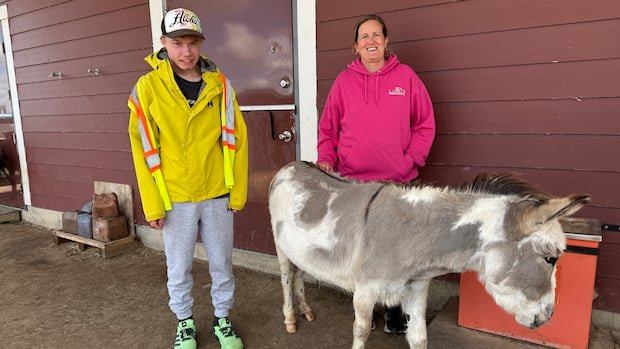
The farm boasts a rich array of animals, including alpacas, donkeys, miniature horses, goats, pigs, rabbits, and cats. Residents actively participate in caring for the animals and collecting eggs from the chicken coops.
Staff and residents collaborate in preparing meals using fresh produce and eggs harvested on-site. Zacharias highlighted the diverse daily activities, including barn chores, woodworking projects, greenhouse duties, and garden maintenance.
Following the success of the Aberdeen farm, a second group home was inaugurated in Biggar, Sask., last month. The rural municipality contributed 100 acres of land, while Farm in the Dell and the community rallied to fund the construction of two five-bedroom homes. Ten adults currently reside in the Biggar facility, supported by a team of 15 to 20 employees.
Zacharias expressed aspirations for the Farm in the Dell model to expand into additional communities. The organization requires an annual budget of approximately $3 million from the Ministry of Social Services to sustain operations at both locations.
The Ministry of Social Services disclosed its funding of nearly 3,000 residential spots for adults with cognitive disabilities, affirming the absence of a waitlist for group homes. Notably, the province is set to construct ten new group homes, including a specialized facility for clients with cognitive disabilities and elevated medical support needs. Completion of nine homes is anticipated within the 2026-27 fiscal year, with the tenth slated for early 2028.