

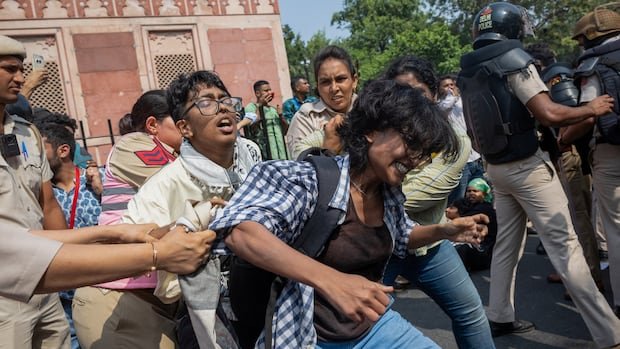

Indian authorities implemented stringent security measures in New Delhi on Saturday, detaining numerous protesters as part of the youth-led “Cockroach” movement’s efforts to escalate a nationwide protest against a controversial voter list revision. The revision has sparked discontent towards Prime Minister Narendra Modi’s Hindu nationalist government and election officials.
Police intervened to disband the protest before it commenced, intercepting demonstrators en route to Jantar Mantar, the designated protest location in the heart of the capital. Some protesters were physically removed and transported to temporary holding facilities. Key figures of the Cockroach Janta Party (CJP), opposition politicians, and student activists were apprehended prior to their arrival, effectively disrupting the protest’s commencement.
The security crackdown extended beyond the protest area, with police conducting vehicle searches at entry points to the capital. Jantar Mantar was sealed off, and anti-riot vehicles equipped with tear gas launchers were stationed along important routes. Additionally, restrictions on mobile internet access and city areas were imposed, further impeding the protesters.
Authorities reportedly denied permission for the protest citing a late submission of the request. Sambit Patra, a spokesperson for Modi’s party, dismissed the demonstrators as “anarchic elements” and asserted that their efforts had been thwarted.
The extensive crackdown highlighted the authorities’ resolve to quash a rapidly growing protest movement that has mobilized numerous young individuals, garnered support from the opposition, and intensified scrutiny of Modi’s leadership. The protests coincide with a politically sensitive period following earlier demonstrations by the movement that led to the resignation of Modi’s education minister due to exam paper leaks.
Amid heightened security measures around the protest site, movement leaders Abhijeet Dipke, Saurav Das, and Ashutosh Ranka were detained upon arrival at Delhi airport. The movement criticized the pre-planned police intervention to disrupt the peaceful demonstrations before reaching the protest location.
Despite warnings against assembling in groups and strict security measures, some protesters managed to breach police barriers, chanting slogans against Modi and election officials before being detained. The police response showcased a significant display of force in a city where dissent has been curbed under Modi’s administration.
The ongoing protests center on the Election Commission’s contentious voter list revision, which the opposition alleges has disenfranchised millions of eligible voters. Protesters demand the resignation of the chief election commissioner and the cessation of the revision, which has reportedly excluded over 130 million names from voter lists. The Election Commission and government refute claims of voter manipulation, citing the revision’s purpose to eliminate duplicate and ineligible entries.
The dispute has become a focal point for opposition parties aiming to challenge Modi’s ruling party. The planned demonstration follows a series of protests in New Delhi, where opposition leaders, including Rahul Gandhi, were briefly detained by police. The opposition accuses the commission of bias in favor of Modi’s party, alleging that voters supporting opposition parties have been disproportionately affected by the exclusions.
For the CJP movement, the voter list controversy presents an opportunity to expand its activism. Originating online and gaining momentum through various protests, the movement gained prominence with the education minister’s resignation in July, marking a rare setback for Modi’s government. The protests pose a challenge for Modi midway through his third term, with upcoming state elections in BJP-controlled states serving as pivotal tests for the party’s standing.