

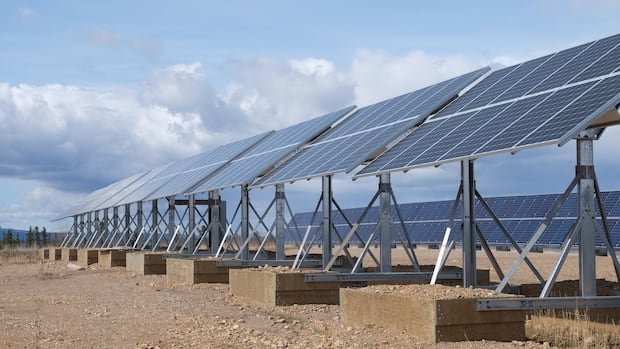

The Northwest Territories (N.W.T.) government is pushing for an increase in the use of renewable energy by power companies. However, experts point out that current limitations exist due to financial constraints and aging infrastructure. Last year, the government directed the N.W.T.’s Public Utilities Board to promote the growth of renewable energy through various measures. One directive aims to raise the cap on the amount of renewable power that independent producers, like community energy projects and individual homeowners, can contribute to the local grid.
Presently, the limit stands at 20% of the annual average load demand for each community, but the government proposes raising it to 30%. Several communities have already hit the existing cap, and an increase would pave the way for more renewable energy initiatives in the region. N.W.T.’s two main power companies, Naka Power and the N.W.T. Power Corporation (NTPC), have indicated their commitment to facilitating this expansion, with specified boundaries, emphasizing that surpassing 30% would necessitate mitigations.
The rationale behind setting limits, as explained by utilities, is that incorporating renewable energy disrupts the efficiency and reliability of diesel generators due to the variable nature of renewable sources. This can lead to financial losses for companies and jeopardize aging systems. An engineering study commissioned in 2021 by the territory highlighted that the N.W.T.’s electricity systems could safely handle up to 45% renewable energy generation, requiring additional infrastructure such as battery storage systems and microgrid controllers beyond that threshold.
Lynne Couves from the Pembina Institute underscored the challenges faced by outdated systems in integrating with advanced renewable energy technologies. Renewable energy production, especially from sources like solar, is subject to fluctuations based on weather conditions, time of day, and season, making it unpredictable in terms of electricity input into the system. Couves emphasized that grid design should factor in electricity demand variations to determine the optimal energy generation mix, including solar and wind.
Various communities, such as Colville Lake and Inuvik, have already initiated hybrid energy projects integrating batteries and solar arrays, supported by federal funding. However, there are cost implications for utilities. A 2021 consultant’s report highlighted the potential revenue loss for utility companies from independent renewable generation, estimating significant losses if the existing capacity limits are upheld.
Dennis Bevington, president of Stand Alone Energy Systems Ltd., emphasized the importance of storage in supporting increased renewable energy adoption, noting that batteries play a crucial role in stabilizing energy systems. While batteries are essential for grid modernization, they come with costs that need to be considered against the benefits they offer in terms of system stability and cost savings in the long run.
The ongoing Public Utilities Board proceeding is expected to continue into 2027, with stakeholders and intervenors set to provide feedback on the proposed changes in March, followed by a public hearing in June.