

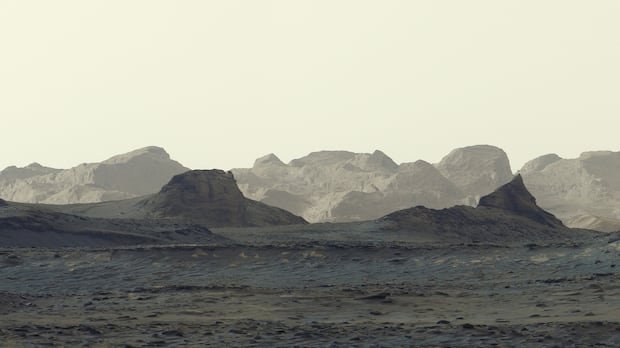

NASA has unveiled a captivating photograph capturing the break of day on the Martian terrain, taken by the Curiosity rover, showcasing sunlight illuminating rugged peaks formed billions of years ago as the car-sized vehicle continues its exploration of Earth’s neighboring planet. Curiosity touched down in the Gale Crater near the Martian equator in 2012 and has been scaling Mount Sharp, a towering five-kilometer-high mountain, since 2014. The photo was snapped by the rover’s Mastcam camera approximately an hour after sunrise, revealing wind-sculpted cliffs in the background. Ashwin Vasavada, a planetary scientist at NASA’s Jet Propulsion Laboratory and the Curiosity project scientist, noted that the bright craggy peaks in the distance represent a distinct rock layer unlike any encountered by the rover thus far.
According to NASA, it is believed that wind-blown sediment from nearby volcanic activity settled in the crater and solidified into rock, which was then shaped into ridges called yardangs over eons by wind erosion. This yardang layer likely formed around three billion years ago, coinciding with the mountain’s formation, and stretches approximately 16 kilometers across Mount Sharp’s northwestern regions. Vasavada mentioned that the layer appears to have been deposited later and is situated above an unconformity, signifying a temporal gap where previous layers eroded before new layers were laid down.
The rover has made a gradual ascent up Mount Sharp, achieving an elevation gain of nearly a kilometer, the highest ever climbed on Mars, as confirmed by NASA. Mount Sharp comprises layers that chronicle various geological periods of the planet. By studying these layers, scientists have gleaned insights into past bodies of water such as lakes and streams that once covered this area during a time when Mars was wetter and warmer. NASA anticipates that Curiosity will reach the yardang layer by 2027 or 2028, enabling it to conduct detailed geological examinations using its instruments.
Curiosity has been dedicated to investigating the geology and climate of Mars, as well as assessing whether the planet could have supported microbial life in the past. It is one of two NASA rovers active on Mars, with the Perseverance rover currently exploring the perimeters of Jezero Crater in the planet’s northern hemisphere. The recent image captured by Curiosity of the Martian dawn presents a surreal vista, evoking a sense of wilderness akin to a journey through Monument Valley, Arizona. Vasavada remarked on the unique characteristics of the Martian sky, painted in shades of orange and blue, reminiscent of Earth but unmistakably Martian.