

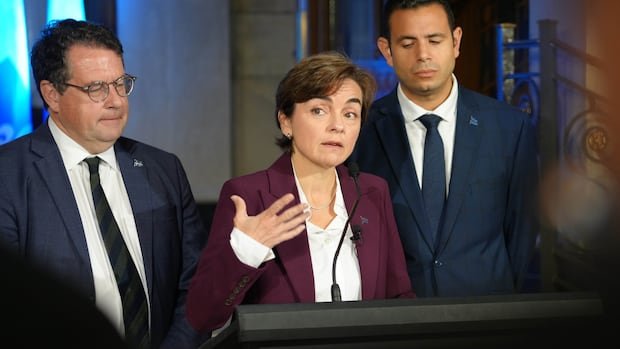

The head of the Coalition Avenir Québec, Christine Fréchette, is facing criticism from political rivals for suspending her election campaign and calling a cabinet meeting amidst the ongoing trade dispute with the United States. At the recent gathering, Fréchette, acting as premier, discussed Quebec’s response to Canada’s retaliatory tariffs and unveiled new measures to support businesses and the economy during escalating tensions.
Questions have arisen about whether a caretaker government leader overstepped boundaries. Fréchette kickstarted her campaign with significant joint announcements with Prime Minister Mark Carney, securing a lucrative Churchill Falls deal valued at around $70 billion and a shipbuilding contract for Chantier Davie shipyard in Lévis, Quebec. This move allowed her to position herself as an economic frontrunner and highlight the trade war as a central campaign issue.
Leading up to the meeting, Fréchette faced accusations of leveraging the tariff conflict for electoral gain, except by Québec Solidaire. Parti Québécois Leader, Paul St-Pierre Plamondon, criticized her tactics, stating that instilling fear is not a sound economic strategy and accused her of diverting attention from the Coalition Avenir Québec government’s performance over the past eight years.
Criticism continued throughout the week, with Quebec Liberal Party Leader, Charles Milliard, noting that no other Canadian premier had held a cabinet meeting or made major announcements in response to the new tariffs. Milliard labeled the meeting as a “charade” and criticized Fréchette’s actions.
Fréchette defended her decisions, emphasizing the need to address real-world challenges and adapt strategies accordingly. In an interview, she underscored the importance of defending Quebecers’ interests, particularly in areas like the French language and supply management during U.S. negotiations.
Political analyst Antonine Yaccarini discussed the dilemma faced by Fréchette, acknowledging that while she benefits from the crisis, she is fulfilling her duties as Quebec’s premier. Yaccarini highlighted the complexity of the situation and the necessity for the current government to handle various issues until the new cabinet is established.
Given the caretaker government status, Fréchette must exercise caution, according to Daniel Béland from the McGill Institute for the Study of Canada. The caretaker convention dictates that governments should refrain from implementing significant changes that could bind the incoming administration. Although Fréchette’s recent measures aimed at supporting local companies garnered attention, they were criticized by the PQ and Liberals for different reasons.
As the campaign intensifies, Fréchette’s opponents believe her focus on the tariff issue has overshadowed other crucial matters. The upcoming leader debates are anticipated to provide a platform for discussing a wider range of topics before voters head to the polls on October 5.