

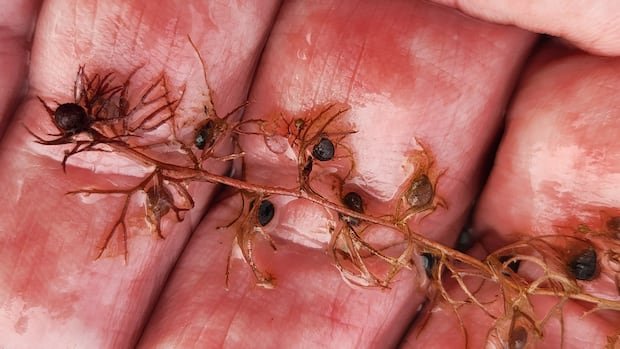

Plant enthusiast Klaus Koehler made a remarkable discovery while exploring the Sylvia Grinnell Territorial Park near Iqaluit in July. He stumbled upon a plant species rarely observed in the Arctic, which he believes could have implications for the spread of invasive species in Northern regions as the climate continues to warm.
Koehler encountered a peculiar brownish plant known as bladderwort when he reached into a pond during his walk. Although inconspicuous to the untrained eye, Koehler recognized the unique characteristics of the plant upon closer inspection.
Covered in small black bladder-like structures containing partially digested flies, the carnivorous bladderwort is typically found in more temperate regions and seldom ventures into the tundra.
This discovery is only the second known instance of bladderwort growing in the area, with the first documented sighting dating back to 2012 when a team of scientists located samples of the plant near Kimmirut, approximately 120 kilometers southwest of Iqaluit. The findings were documented in the scientific journal Phytokeys.
During three expeditions to the Arctic, the research team identified over 30 previously undocumented plant species within the Arctic archipelago.
Koehler suggests that this finding could indicate a shift in the climate. While invasive species have had limited presence in the Arctic due to the harsh conditions, the warming climate is now creating a more favorable environment for plants that are typically not native to the region.
He anticipates that this trend will alter the ecosystem significantly as vegetation expands northward with the changing climate. Paul Sokoloff, a senior research assistant at Ottawa’s Museum of Nature, shares this concern, having been part of the team that discovered bladderwort in 2012.
Apart from natural dispersal, Sokoloff highlights other potential vectors for introducing new plant species into Arctic ecosystems, such as birds, cargo ships, and footwear of visitors to the Arctic.
The encroachment of invasive species poses a threat to native plants, as seen in other parts of Canada where species like phragmites, an invasive grass from Eurasia, have caused significant ecological damage.
While Koehler’s discovery may not have immediate adverse effects, Sokoloff emphasizes the importance of monitoring and understanding the potential impacts of new plant species migrating into the Arctic due to climate change.
Research indicates that over 2,500 species have the capacity to invade Arctic regions, potentially displacing native species. Scientists continue to study the implications of climate change on plant migration patterns in the Arctic.
Koehler intends to collect a sample of the bladderwort found in Iqaluit for further analysis at the Museum of Nature, aiming to contribute valuable insights into the plant’s expansion northward.