

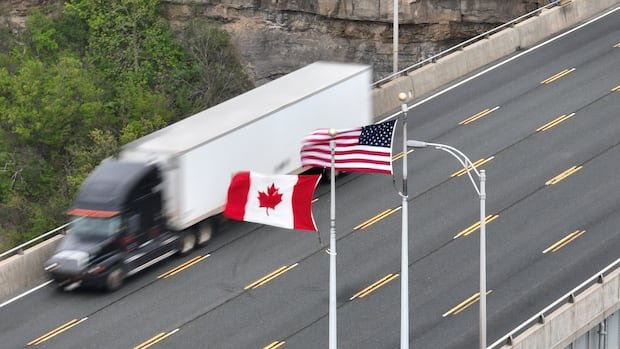

A fresh report warns of significant job losses and economic implications on both sides of the Canada-U.S. border if the Canada-U.S.-Mexico Agreement (CUSMA) breaks down amid ongoing trade talks to prevent new U.S. tariffs. The report, conducted by Oxford Economics for the Canadian American Business Council and released recently, assessed three potential outcomes of the trade negotiations between the U.S. and Canada.
The study outlined scenarios involving the maintenance of current tariffs, a breakdown of the CUSMA agreement, and a successful renegotiation leading to an improved trading relationship. In case of a CUSMA termination, an estimated 214,000 American and 102,000 Canadian jobs could be lost compared to the status quo. Conversely, a successful renegotiation could result in job gains of 137,000 in the U.S. and 98,000 in Canada.
Beth Burke, CEO of the Canadian American Business Council, emphasized the importance of the U.S.-Canada trading relationship for both countries’ prosperity, stressing the potential loss of jobs, stability, and security if the agreement collapses. The report also projected significant GDP impacts, forecasting a $1.04 trillion loss for the U.S. economy and a $271 billion decrease for Canada by 2035 in case of a breakdown, leading to heightened inflation and reduced real disposable income.
The worst-case scenario would particularly affect manufacturing sectors in the U.S., with auto, wood product, and metal product industries facing substantial losses. Similarly, Quebec and Ontario would bear the brunt in Canada if CUSMA were to fail, especially within the manufacturing domain.
Efforts are ongoing to avert new 50% tariffs on various Canadian exports, constituting 5% of Canada’s export to the U.S., before the looming August 19 deadline. Trade representatives from both countries are engaged in negotiations, aiming to present a possible deal to President Trump soon. Canadians may witness concessions from both sides to reach a resolution as talks progress.
If the negotiations fail and new tariffs are imposed, manufacturers in central Canada, particularly in sectors like cement, concrete, paper products, wood, computers, electronics, plastics, and rubber, would be severely impacted. Provinces such as Ontario, New Brunswick, and Quebec are projected to be most affected due to their reliance on these industries, while others like Saskatchewan, Alberta, and Newfoundland and Labrador are expected to face lesser impacts.