

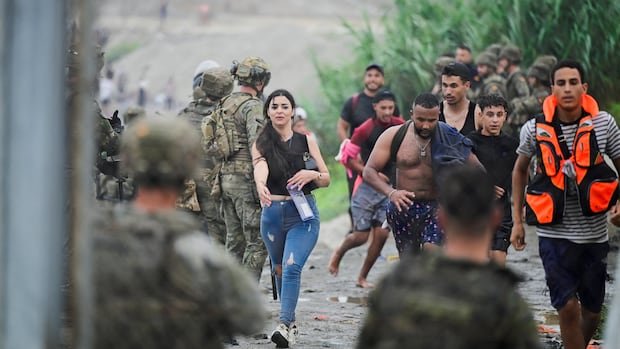

Spain and Morocco have fortified the border fence of a Spanish enclave to prevent mass crossings, effectively reducing the influx of tens of thousands of people arriving by sea and land. The Spanish enclave leader, Juan Jesus Vivas, confirmed that 57 individuals have tragically lost their lives during the recent surge, with around 60,000 migrants entering Ceuta in a short period.
In response to the situation, over 48,300 migrants voluntarily returned to Morocco by Friday evening, as reported by Spain’s Interior Ministry. The overwhelming influx into Ceuta, a small Spanish territory in North Africa, has sparked concern and controversy across Europe. France announced heightened border checks with Spain, while Italy threatened to suspend Spain from the EU’s open border scheme.
Moroccan authorities utilized water cannons, batons, and tear gas to deter more people from breaching the border into Ceuta. Spanish officials vowed to swiftly expel those who entered illegally, despite legal constraints following a court ruling on border rejection rules. Spanish Prime Minister Pedro Sanchez condemned the mass crossings as a violation of Spain’s territorial sovereignty and urged Morocco to intensify efforts to control the situation.
Ceuta and Melilla, another Spanish autonomous city in northern Morocco, represent the EU’s sole land borders with Africa. These regions periodically witness spikes in attempted crossings by migrants aiming to reach Europe, but the recent surge was unprecedented. Factors contributing to the sudden influx may include a recent Spanish Supreme Court ruling barring the immediate return of migrants intercepted at sea en route to Ceuta or Melilla.
Migrants typically swim from Moroccan towns like Fnideq or Belyounech to reach Ceuta, covering distances of up to five kilometers. Despite reinforced security measures, some groups sought alternate routes along the coast to evade the border fence. The situation prompted a swift response from European nations, with France increasing police presence on the Spanish border and other countries considering border control measures.
Migration remains a contentious issue in Europe, particularly with the rise of right-wing political parties in the aftermath of the 2015 refugee crisis. European leaders expressed varying stances on the recent events, with calls for border protection and solidarity within the EU. Amid the ongoing debate, Spain’s government emphasizes the economic contributions of immigrants and recently offered a mass amnesty program to integrate undocumented residents.
The escalation at the Ceuta border prompted international reactions, with Italy criticizing Spain’s citizenship grants to irregular immigrants. Spanish officials denounced Italy’s stance as divisive, emphasizing the need for solidarity and cooperation among EU nations. The situation underscores the complex dynamics of migration policy and border control within the European context.