

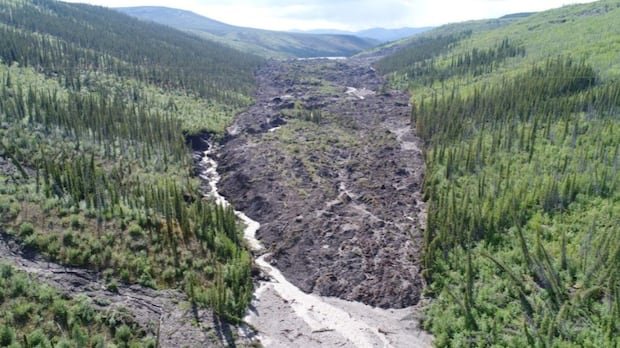

Recent research delved into two significant landslides in the Mackenzie River basin that occurred around ten years ago. These landslides took place on the Johnson River in 2017 and the Redstone River in 2018. Termed as “permafrost detachment slides,” researchers identified them as unique events not directly linked to permafrost thawing.
Joseph Young, a former PhD student at the University of Alberta and the lead author of a study published in Geophysical Research Letters last month, highlighted the distinction. According to Young, traditional permafrost failures in regions occur gradually from the top due to rising air temperatures and increased precipitation that lead to permafrost thawing over decades.
In contrast, permafrost detachment slides involve sudden failures approximately 20 meters below the surface. Instead of the typical top-down enlargement process, these slides experience rapid and bottom-up failures, as explained by Young.
Characterized by their large and swift nature, permafrost detachment slides can displace massive amounts of material in a matter of days that would otherwise take decades through standard permafrost failure processes.
The Redstone River landslide, occurring in August 2018, moved an estimated 4.5 million cubic meters of earth into the river basin. On the other hand, the Johnson River slide, happening in August 2017, displaced around 18 million cubic meters, equivalent to filling approximately 7,200 Olympic swimming pools.
‘Distinctive Land Alterations’
Eric McLeod, who witnessed the Johnson River slide from an aerial perspective, observed the landscape evolution during his flights over the area in subsequent years.
McLeod recounted flying over the region in May 2017 and witnessing a significant portion of land sliding into the river. The helicopter pilot also noted the complete descent of the land down the hill, obstructing the river and forming a lake.
He described the land as if it had suddenly acquired stretch marks, unlike other gradual melt-away occurrences. McLeod landed at the Johnson River slide site shortly after the incident, comparing some displaced earth pieces to the size of houses.
Impact of 1995 Wildfire on Landslides
Young attributed the onset of the slides to wildfires that occurred in 1995, which initiated the process leading to the landslides.
According to co-author Steve Kokelj from the Northwest Territories Geological Survey, the wildfires eliminated organic material, directly affecting the top layer of permafrost. Subsequently, significant disturbances began emerging within the burnt areas about 15 to 20 years after the fire, penetrating 20 meters underground.
The combination of permafrost warming, compounded by the warming impact of fires and climate change, contributed to these events. Young and Kokelj highlighted that certain indicators precede permafrost detachment slides, offering predictive signals about impending occurrences.
The gradual nature of these phenomena over approximately two decades post-fire provides a silver lining, indicating a slow downslope movement of slopes before a permafrost detachment slide.
Tag: rewrite-pending