

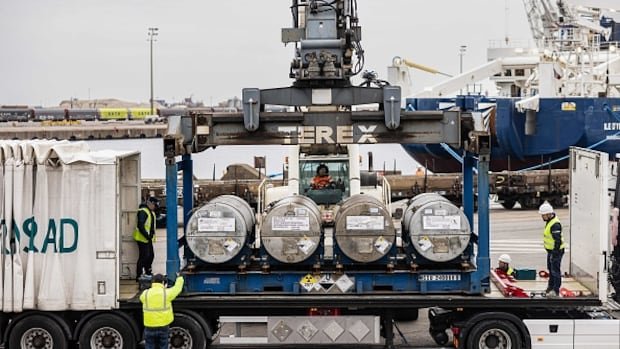

Amidst the Russian military’s occupation of Ukraine’s largest nuclear facility and assaults on the country’s power infrastructure, both Europe and the United States continue to rely on Russian nuclear fuel to operate their electricity systems.
Westinghouse Electric, a Canadian-owned company, is one of the recipients of low enriched uranium (LEU) from Russia for fueling commercial nuclear reactors in the U.S., as per shipping data analyzed by CBC’s investigative team, the fifth estate.
Although the U.S. implemented a ban on Russian enriched uranium imports in August 2024 to reduce dependency on Russian sources and ensure a robust domestic fuel supply, the Prohibiting Russian Uranium Imports Act allows waivers under certain conditions until January 1, 2028.
Reports from the Bellona Environmental Transparency Center in Vilnius, Lithuania, indicated that in 2025 alone, the U.S. imported 400 tonnes of low enriched uranium from Russia valued at approximately $1 billion US. Major recipients included subsidiaries of French-owned Framatome, Global Nuclear Fuel Americas, and Westinghouse.
While the U.S. has restrictions on Russian uranium imports, the European Union and Canada have not imposed such sanctions on Rosatom or Tenex, Russia’s state atomic energy corporation and its export arm, respectively.
According to Dmitry Gorchakov, a nuclear adviser at Bellona, amidst the ongoing conflict and direct threat to Ukraine, countries should aim to reduce their reliance on Russian sources and terminate cooperation.
Westinghouse’s fuel fabrication plant in South Carolina receives shipments of enriched uranium from Tenex, which is then processed into fuel pellets and assembled into fuel rods for use in commercial nuclear power reactors.
Efforts are being made by Western governments and industry to reduce the long-standing dependence on Russian enriched uranium by increasing domestic production and seeking alternative suppliers.
Westinghouse, a significant player in the U.S. nuclear sector, has been involved in agreements to support Ukraine in replacing Russia as the country’s nuclear fuel supplier. The company’s partnerships with Ukraine’s Energoatom include supplying fuel and constructing new reactors.
Despite Canada’s sanctions against numerous Russian entities and individuals, Rosatom and Tenex are not among the sanctioned entities. The European Union has imposed multiple rounds of sanctions on Russia but has not banned the import of Russian enriched uranium.
It is crucial for Western countries to avoid engaging with Russian state nuclear entities to prevent bolstering enterprises tied to Moscow’s actions against Ukraine. Advocates emphasize the importance of diverting financial flows away from Russian state enterprises like Rosatom.