

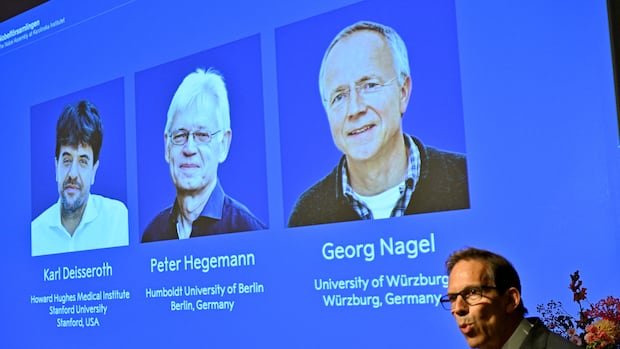

Karl Deisseroth, Peter Hegemann, and Georg Nagel have been awarded the 2026 Nobel Prize in Physiology or Medicine for their groundbreaking work on light-gated ion channels and optogenetics, announced by the Nobel committee in Stockholm on Monday. Optogenetics has significantly transformed our comprehension of the brain, allowing researchers to uncover neural circuits controlling specific memories, emotions, and behaviors relevant to neurological and psychiatric conditions. The method is also being explored in clinical settings to potentially restore vision in individuals with visual impairments.
The recipients, Deisseroth from the U.S., Hegemann, and Nagel from Germany, expressed surprise upon learning about their prestigious win, as shared by Thomas Perlmann, a professor at Sweden’s Karolinska Institute and a member of the Nobel committee. The Nobel Prize carries a monetary award of 12 million Swedish crowns (approximately $1.7 million Cdn).
Upcoming Nobel Prize announcements include chemistry and physics on Tuesday and Wednesday, literature on Thursday, the peace prize on Friday, and the economics prize on October 12. The Nobel Prize, established by Swedish chemist and entrepreneur Alfred Nobel, aims to honor individuals who have made significant contributions to humanity. Nobel, known for inventing dynamite, was also a multilingual poet and playwright. The prizes, divided into five categories, were first awarded five years after his passing in 1896.
The laureates will be officially presented with their Nobel Prizes on December 10, marking the anniversary of Alfred Nobel’s death.