

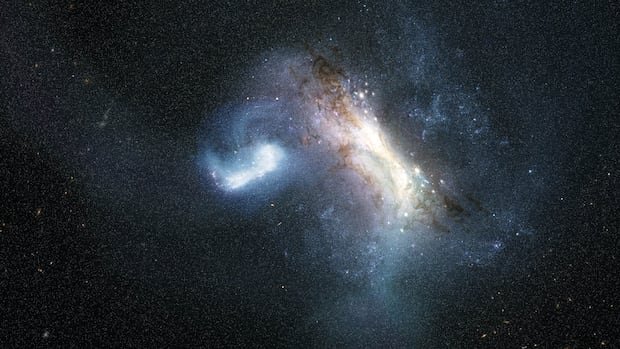

A recent study has shed light on the complex evolution of the Milky Way galaxy, which is home to billions of stars, including our sun. Scientists have uncovered evidence of a significant event in the Milky Way’s early history: the absorption of a smaller galaxy around 11.8 billion years ago when the universe was much younger. This merger, the earliest known in the Milky Way’s history, highlights how the galaxy grew not only by creating its own stars but also by incorporating smaller galaxies through gravitational forces.
The dwarf galaxy that merged with the Milky Way roughly 11.8 billion years ago was estimated to contain stars with a mass equivalent to 500 million times that of the sun at the time of the merger. Researchers used data from the Hubble and Gaia telescopes to analyze stellar clusters within the Milky Way’s innermost 20,000 light-years, studying their age, composition, and movements. This merger occurred approximately two billion years after the Big Bang, leading to the incorporation of stars from the dwarf galaxy, now known as Low-energy-Kraken-Heracles (LKH), into the Milky Way.
According to lead author Davide Massari from the National Institute for Astrophysics in Bologna, Italy, this discovery marks the first merger event experienced by the Milky Way in its early stages. The study suggests that the merger infused the Milky Way with a significant number of stars, interstellar gas, and dark matter, fueling star formation.
Massari described the merger as “peaceful” in terms of star interactions but “explosive” concerning gas collisions, likely triggering the formation of new stars. The Milky Way has been involved in two other major mergers, including the absorption of the Gaia-Sausage-Enceladus dwarf galaxy and the ongoing merger with the Sagittarius dwarf galaxy. Each merger has influenced the galaxy’s evolution, potentially impacting the formation of our solar system and Earth.
Stellar remnants from the dwarf galaxy that merged with the Milky Way are believed to still exist within the galaxy, particularly in stellar clusters. However, identifying these stars is challenging due to the abundance of interstellar dust. Understanding the Milky Way’s past through these mergers contributes to answering fundamental questions about our origins.