

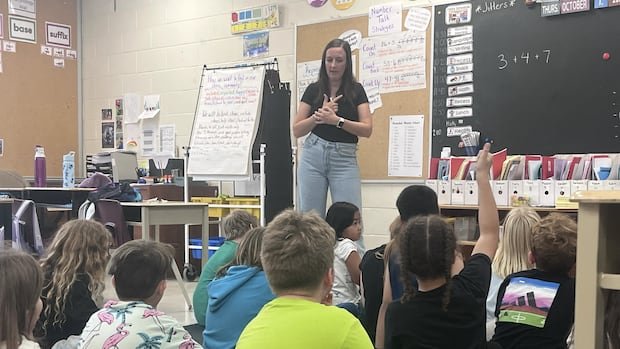

Earlier this week, Kendra Corbett was teaching her Grade 3 students about addition using a blackboard. She explained the steps to solve the problem and engaged the students in the process. Later, she divided the class into groups for different activities, including math games and using base ten blocks to understand three-digit numbers. Corbett emphasized the importance of students grasping the meaning of numbers and their magnitude for future success in math.
Recent international and provincial assessments have highlighted a decline in math skills among Canadian students, a trend that predates the pandemic. Experts are calling for a reevaluation of math education, suggesting that numeracy should receive the same level of attention as literacy. John Mighton, a Canadian mathematician, expressed concerns about the increasing number of students struggling with basic math concepts, emphasizing the broader implications of this trend on the country’s future.
Mighton, who founded JUMP Math in 2002, advocates for a more structured approach to teaching math, especially for students who are still developing their foundational knowledge. He believes that focusing on building a strong mathematical foundation and providing ample practice can lead to better problem-solving skills in students.
As artificial intelligence continues to advance, having a solid understanding of math is crucial for navigating challenges effectively. Mighton warns that without mathematical knowledge, individuals may make poor decisions when faced with complex problems involving risk or probabilities.
There is a growing consensus among educators for more systematic and teacher-led math instruction, similar to the recent shift in literacy teaching methods. While not advocating for rote learning, experts like Mighton stress the importance of evidence-based practices and regular assessments to track students’ progress and make necessary adjustments to enhance their learning experience.
Neuroscientist Daniel Ansari also emphasizes the need for breaking down math concepts into simpler steps to facilitate better understanding for students. He suggests striking a balance between explicit instruction and allowing children to discover concepts on their own, always considering what is developmentally appropriate for learners.
In Orangeville, Ashley Kozak, the K-12 math lead for Upper Grand District School Board, has implemented a comprehensive plan to enhance early math learning. This plan includes providing support to teachers, creating new resources, conducting early math screenings, and offering targeted tutoring for schools in need. The board has seen improvements in math education following updated training for teachers and principals, leading to enhanced student confidence and problem-solving abilities.
Overall, the focus is on building a strong mathematical foundation, promoting critical thinking and problem-solving skills, and ensuring that students are equipped with the necessary knowledge to navigate the challenges of the future effectively.