

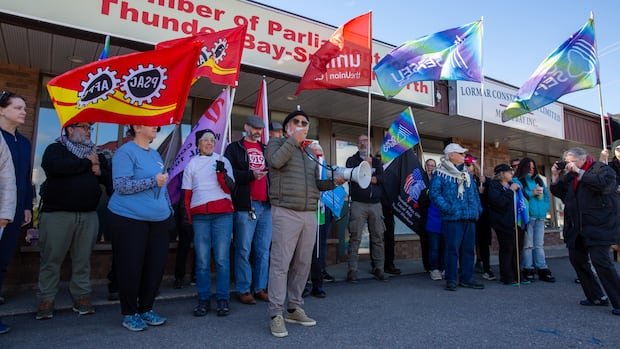

Labour activists staged a demonstration outside Patty Hajdu’s office in Thunder Bay, Ont., expressing concerns that proposed revisions to federal laws could grant the jobs minister unprecedented authority to halt strikes, potentially discouraging employers from engaging in genuine negotiations. The Thunder Bay and District Labour Council organized the protest, gathering approximately 50 individuals to voice opposition to Bill C-39, which seeks to make significant adjustments to Canada’s collective bargaining regulations.
Carlos Santander-Maturana, the council’s president, highlighted that Bill C-39 empowers the minister to send workers back to work post a brief mediation, leading employers to potentially negotiate less earnestly due to the government’s ability to intervene and end strikes. The legislation, also known as the Building Canada Strong Act and introduced by Prime Minister Mark Carney’s government, aims to expedite approvals for major projects, streamline review processes, and establish zones of “national interest” for certain project approvals.
The proposed changes to Section 107 of the Canada Labour Code, included in the bill, grant the responsible minister, in this case, Hajdu, broad authority to “maintain or secure industrial peace.” Since 2024, the federal government has been criticized for utilizing Section 107 to force striking employees back to work and initiate binding arbitration.
In response to the backlash, Hajdu’s office asserted that the amendments would not impede the right to strike. According to Jennifer Kozelj, Hadju’s press secretary, Bill C-39 does not introduce new intervention powers but outlines specific preconditions that must be met before any ministerial intervention. The government’s stance is to safeguard the rights of Canadian workers, including the right to strike.
Union representatives in Thunder Bay, however, expressed reservations about the proposed changes, believing they do not serve the best interests of workers. David Lennox, vice president of Unifor Local 1075, voiced concerns, particularly regarding Section 107 of the bill, stating that Unifor cannot support it. Notably, Unifor represents employees at the Alstom plant in Thunder Bay, where a recent $4.7 billion contract for Via Rail was announced, bringing relief to workers amidst past uncertainties.
Dawn Bellerose, the secretary-treasurer of the Canadian Union of Public Employees (CUPE) Ontario, criticized the proposed legislation, deeming it detrimental to the workers who have contributed to the nation’s progress. She emphasized the challenges faced by workers amid escalating living costs and trade tensions with the U.S., underscoring the need for fair bargaining opportunities to support families and livelihoods.