

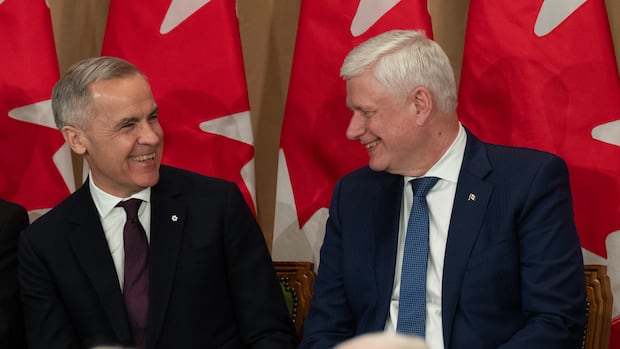

Former Prime Minister Stephen Harper revealed that he had extended an offer to Mark Carney, who was then the governor of the Bank of Canada, to join his Conservative government in 2012, although not immediately as finance minister.
In his newly published memoir Here for Canada: Memoirs of the 22nd Prime Minister, Harper states that he informed Carney that the finance minister role was already filled but suggested that he would be the top contender for the position when it became available.
“I clearly did not propose he take the minister of finance position, as it was not open at that time. However, I made it known that if he decided to join the government, he would be the primary candidate should the position open up,” Harper writes.
During an interview with CBC News amid the 2025 Liberal leadership contest, Carney stated that Harper had indeed “asked me if I would be his finance minister in 2012.” He expressed at the time that it would be inappropriate to transition directly from the governorship of the Bank of Canada to partisan politics.
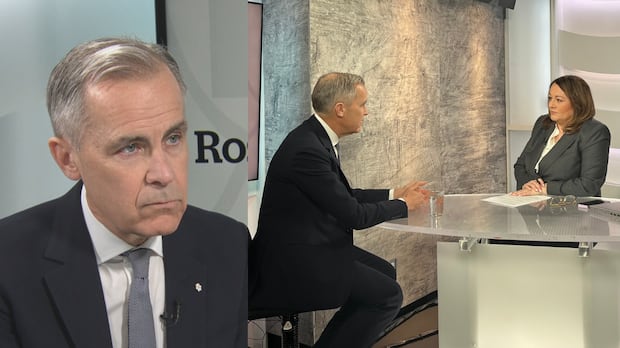
Chief political correspondent Rosemary Barton speaks with Liberal leadership candidate Mark Carney in his first Canadian interview to discuss his vision for Canada if elected.
In his memoir, which was published on Tuesday, Harper notes that while Carney was a “highly effective” governor of the bank, his finance minister, Jim Flaherty, was increasingly concerned following the 2011 election that Carney might be harboring political ambitions and could be interested in leading the Liberal Party — a notion that was widely circulated at the time.
“This was a significant concern for us,” Harper states.
Harper mentions that he discussed this matter with his chief of staff, Nigel Wright, who suggested that offering Carney a position could either secure his loyalty to the government or compel him to dismiss any thoughts of seeking the Liberal leadership, given his non-partisan role as bank governor.
“Mark took some time to think about the opportunity, ultimately deciding he should refrain from entering partisan politics,” Harper explained, adding that Carney soon thereafter accepted the top position at the Bank of England.
-
Mark Carney says former prime minister Stephen Harper asked him to be finance minister
-
Former prime minister Harper accuses Carney of overblowing role during financial crisis
The reference to Carney is merely a brief mention in the extensive nearly 650-page memoir. Harper felt it was necessary to address the subject, as it has “occasionally surfaced in the media.”
The memoir provides Harper’s insights regarding his time in Canadian politics, covering everything from the consolidation of the right under the modern Conservative Party to a decade of governance.
Not consulted on ‘barbaric cultural practices hotline’
Additionally, it includes a rare personal account of Harper’s final election campaign and the loss of his government in 2015.
Harper mentions that he contemplated resigning from leadership in the summer of 2014 to revitalize the party.
After deciding to continue leading his party into what he anticipated would be a challenging election, Harper resolved to remain until shortly after Canada’s 150th anniversary of Confederation on July 1, 2017, before initiating a leadership contest.
Harper also shares that he only became aware of one of the most contentious incidents of the 2015 election — his party’s support for a “barbaric cultural practices hotline” — while preparing for the French debate in Montreal, when the news “flashed across my screen.”
The announcement regarding the proposed hotline, which frustrated moderate Conservatives and hampered the party’s efforts to engage with multicultural communities for years afterwards, was primarily presented by former cabinet ministers Kellie Leitch and Chris Alexander.
Harper expressed that he was “furious” upon discovering the policy, which he claimed he had not been consulted about and had to defend during the campaign.
The memoir covers decades of Canadian political history, detailing Harper’s direct confrontations with Russian President Vladimir Putin at G8 summits, his response to the 2008 parliamentary crisis — when opposition parties attempted and failed to establish a coalition to displace the Conservatives — and his personal experience during the 2014 shooting on Parliament Hill, which occurred while he was without his usual security detail.
Occasionally, the former prime minister reflects on contemporary issues. Although he participated in the World Economic Forum (WEF) in Davos twice during his administration, he now expresses opposition to it.
If he were serving as prime minister today, Harper states that he would terminate the Canadian government’s involvement in the WEF — an event he characterizes as a once-valuable platform that has evolved into a venue for promoting the “narrow interests of its globalist, elitist attendees.”
Tag: rewrite-pending