

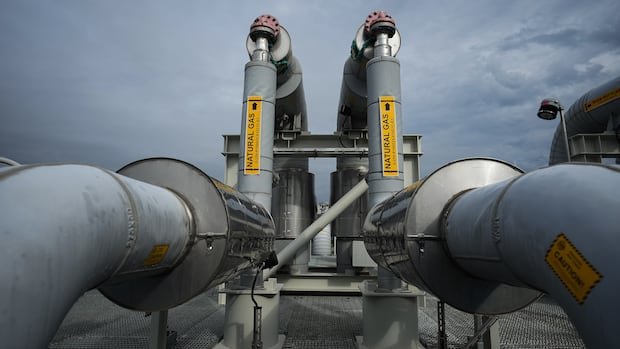

Prime Minister Mark Carney asserts that Canada significantly contributes to American economic growth by exporting natural gas to the U.S., raising questions about the potential impact if Canada were to cease these exports. Energy products like oil and natural gas have not been used as bargaining tools in the ongoing trade tensions between Canada and the U.S., sparking differing opinions among Canadian leaders.
Carney emphasized the importance of Canadian energy exports to the U.S., stating that Canada supplies the majority of their natural gas, electricity, and crude oil imports. While the U.S. heavily relies on Canadian natural gas imports, accounting for almost all of its non-domestic supply, it represents only a small fraction of total U.S. natural gas consumption.
According to Dulles Wang, director of Americas gas and LNG at Wood Mackenzie, the actual percentage of Canadian natural gas imports to the U.S. is lower than previously reported, around five percent. The intricate network of natural gas pipelines between Canada and the U.S. facilitates constant cross-border gas flows, supporting various sectors from residential heating to industrial operations.
Enbridge, headquartered in Calgary, stands as the largest natural gas provider in North America, further solidifying the interdependent energy relationship between the two countries. Despite the relatively small volume of Canadian natural gas compared to U.S. production, Wang highlights the strategic importance of these deliveries in specific regions like the Pacific Northwest.
The potential halt of natural gas shipments from Canada to the U.S. could have detrimental effects on the Canadian energy industry, leading to an oversupply situation and plummeting prices domestically. Wang warns that such a move would be self-sabotaging for Canada, eliminating a crucial market and causing economic repercussions. The Canadian government aims to diversify its energy exports beyond the U.S. market by targeting Asian buyers through projects like LNG Canada and the Ksi Lisims LNG export facility.
In conclusion, maintaining the current energy trade relationship with the U.S. is vital for Canada’s economic stability and energy sector growth, emphasizing the need for strategic planning to expand into new markets while sustaining existing partnerships.