

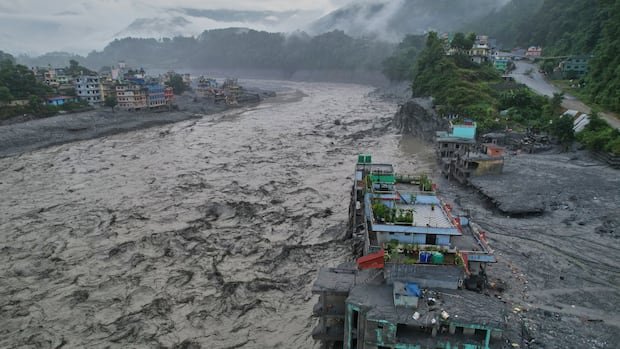

Authorities in Nepal have issued a warning about potential new flooding and advised residents in flood-affected areas to stay vigilant as the water levels in the Bhotekoshi River have risen. Flood alerts were sent to people’s mobile phones early on Sunday as rescue teams worked to clear a key highway linking Kathmandu to one of the hardest-hit regions by the devastating floods that claimed the lives of at least 800 individuals and left over 3,000 missing in Nepal and Tibet.
In Dhading, one of the severely affected areas in Nepal, some residents have started returning to their damaged homes to assess what can be salvaged. Residents were seen sifting through mud and debris in homes with washed-out walls, trying to retrieve belongings. One resident managed to save his chickens, tying them up and transporting them in his truck after finding them alive.
Sharmila Tamang, a resident of Dhading, expressed the devastation, stating, “Everything is finished. Nothing is left. Not even our home.” Workers at a critically damaged power plant initiated inspections on Sunday to evaluate the extent of the damage. This power plant caters to over 20,000 people across four districts.
In Galchhi town, a group of residents sought refuge on a nearby bridge, observing the powerful flow of the river. The aftermath of the floods could be seen along the riverbanks, with homes, vehicles, and farm equipment partially submerged in sediment. Additionally, landslides caused parts of rice terraces to collapse into the river.
Nepal’s disaster agency reported a death toll of 788 with 2,502 missing, while Chinese authorities confirmed 16 deaths and 546 missing individuals on the Chinese side of the border. Among the missing are hundreds of people from various countries who were in the region for work, tourism, or religious purposes. Chinese state media indicated that 261 foreigners were unaccounted for in Tibet, including over 100 Nepalis and others from different nations.
Residents continue to receive ongoing flood warnings, with many homes and businesses still without electricity due to damaged power infrastructure. The Prithivi Highway, a critical supply route for Kathmandu, is undergoing repair challenges in certain sections despite most of it being operational.
The latest flood alerts follow increased water flow warnings from Chinese authorities upstream, as stated by Dharam Raj Uprety, the head of Nepal’s National Disaster Risk Reduction and Management Authority. Flood-affected villagers expressed difficulties in coping with the frequent alarms since the initial floods, highlighting the challenges faced by the elderly and vulnerable individuals.
The flash floods on Wednesday originated from a glacial collapse in the Himalayas, triggering a chain reaction that resulted in catastrophic flooding in Tibet and Nepal. Nepal’s foreign minister emphasized the urgent need for a global response to climate change, attributing the country’s disproportionate share of climate impacts to its minimal contribution to global emissions.
Although the direct link between global warming and the recent calamity is yet to be established, experts warn that as the Earth’s temperature rises due to human activities, the risk of such disasters intensifies, especially in rapidly warming regions like the Himalayas.