

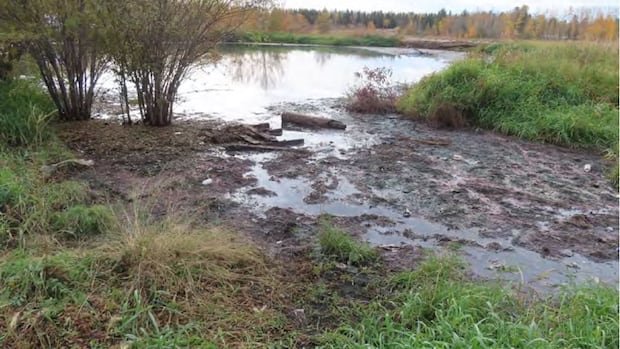

In Fort Providence, N.W.T., efforts are underway to locate the cause of a blockage affecting the sewage lagoon. Inspectors from the N.W.T.’s Department of Environment and Climate Change (ECC) instructed the hamlet in September to address the issue before freezing conditions set in.
During a routine inspection, ECC staff discovered elevated effluent levels in the lagoon’s initial cell, where raw sewage enters. The high levels had breached a corner of the cell, posing a risk of overflow into a second cell. Subsequently, the levels in the second cell were also abnormally high.
The sewage lagoon in Fort Providence consists of five interconnected cells with solids settling in the first cell and liquid flowing into subsequent cells through culverts. According to Dana Bowen, a communications planning specialist at ECC, sunlight and bacteria break down the effluent in the second cell before it progresses through the system and returns to the environment.
Investigations revealed that water levels in the fifth cell were unusually low, indicating a potential blockage hindering the flow. Consequently, maintenance work, including desludging certain sections of the system, is being carried out to identify and address the issue.
An update published on the Mackenzie Valley Land and Water Board website on October 6 mentioned that the hamlet is collaborating with a contractor to locate and rectify the blockage. Currently, there is “no flow” between the first and second cells, prompting the hamlet to temporarily bypass the first cell and utilize the second cell as the primary one. Additionally, pumps are being used to redirect wastewater as required.
Bowen stated that an inspector would revisit the hamlet before the onset of freezing conditions to assess the situation. Fort Providence Mayor Danny Beaulieu directed inquiries to the hamlet’s senior administrative officer, Susan Christie, who was unavailable for comment.