

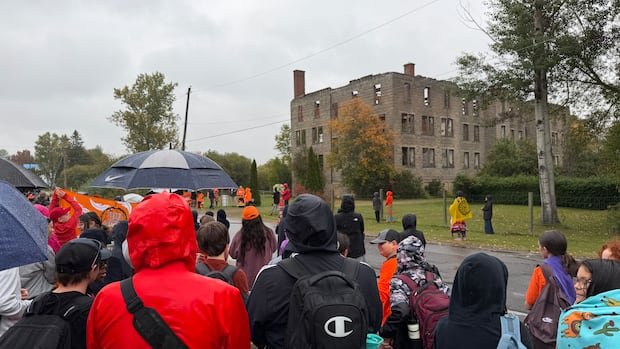

On the National Day for Truth and Reconciliation, Alyssa Traves carried a smudge pot as she approached the old Spanish Indian Residential School. Across the street, a group of school children visited the site, standing solemnly in the rain. Traves, the project manager for the Spanish residential school, described the moment as powerful, witnessing the young children proud of their heritage and identity.
This gathering served as a preview of Traves’ vision for the former school site near Spanish town on Lake Huron’s north shore. From 1913 to 1965, the Spanish school complex housed Indigenous children from 44 communities nationwide. While most buildings have been demolished, the four-story stone structure of the “girl’s school” remains on private property.
Traves, a member of Serpent River First Nation, is initiating plans to attract more visitors to Spanish to learn about the residential school legacy. Utilizing advanced technology, they aim to digitally reconstruct the school complex for virtual tours, showcasing photos, survivor stories, and gradually expanding the narrative.
She also intends to introduce signage with QR codes at the site for visitors, including passing motorists and school groups, to experience the history firsthand. Discussions are ongoing with the Jesuits, who operated the Spanish boys’ school, on their potential role in preserving the narrative.
One significant question is the fate of the girls’ school ruins as preservation discussions progress. Recently, visitors were permitted to explore the decaying structure, left charred by a fire over four decades ago. Local resident Brittany Laurin, reflecting on the site, expressed mixed emotions of sadness, anger, and acknowledgment of its historical significance.
Similarly, 77-year-old Verna Simpson, whose sister attended the school, gazed through the windows, contemplating her sibling’s unspoken experiences. Simpson advocates for preserving the building as a reminder of the past atrocities, acknowledging her relief at not enduring the same ordeal.
Jeannette Commanda, an 85-year-old survivor of the Spanish residential school, emphasized the importance of educating future generations about the hardships endured by former students. While she frequents the site to reflect on her past, Commanda believes the focus should be on teaching children to appreciate their current privileges compared to the harsh realities of the residential school era.
Traves envisions the next project phases aiming to restore various elements of the site and explore heritage designation for the former school building, advocating for its preservation as a monument. She acknowledges the diverse perspectives of survivors and the absence of a clear roadmap for this challenging endeavor.