

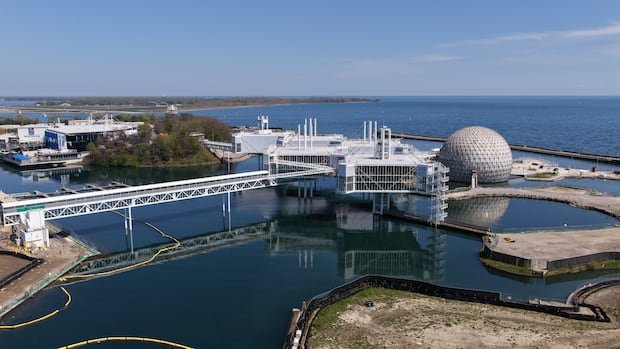

The Supreme Court of Canada is set to listen to arguments on Thursday made by a group challenging the constitutionality of a law that facilitates significant transformations at Ontario Place. This legal battle in Canada’s highest court could have implications that extend beyond the Toronto waterfront attraction established in 1971.
Over the years, Ontario Place has been home to various attractions, including a spherical theater, children’s play zones, a rotating concert stage, and pavilions suspended over the water. The government of Ontario aims to revamp Ontario Place to accommodate a luxurious spa run by a private entity, a relocated Ontario Science Centre, upgraded recreational and shoreline areas, a parking structure, and a provincial police station.
The coalition known as Ontario Place Protectors has contested the province’s Rebuilding Ontario Place Act (ROPA) on the grounds that it shields government actions from judicial review, thus violating the Constitution. They argue that exemptions from environmental and heritage regulations, as well as municipal noise ordinances, represent a breach of public trust.
A lower court dismissed the coalition’s challenge in 2024, and an appeal of the ruling in the provincial Court of Appeal was unsuccessful. However, the Supreme Court agreed in January to hear the case brought by the Ontario Place Protectors.
The coalition asserts that superior provincial courts have the authority to review laws and government actions protected under the Constitution Act, 1867, and offer remedies when governments overstep their powers. They claim that the scope of the Rebuilding Ontario Place Act sets a concerning precedent by curtailing the courts’ essential powers.
Additionally, the coalition is pushing for the recognition of the doctrine of public trust as a fundamental constitutional principle that mandates the protection of natural and cultural assets for public welfare by the government.
Margie Zeidler, a member of the coalition and daughter of Ontario Place’s architect, stresses the significance of the government’s actions beyond the fate of the park, questioning the democratic principles at stake.
In response, the Crown and the Ontario attorney general argue that the case should be dismissed, asserting that the legislation does not create a lawless environment at Ontario Place and that the doctrine of public trust is not a valid reason for invalidating the law.
The case has garnered interest from various interveners, including provinces, First Nations, civil liberties groups, and environmental organizations. The Supreme Court typically delays its rulings, suggesting that a decision on this case may not be reached until the following year.