



Upon receiving a notification from the online marketplace Etsy that 11 of his T-shirt designs featuring the slang term “bruh” had been removed due to a trademark infringement claim, Sam Joseph Karam felt a sense of unease.
“Typically, it’s just one or two listings that get flagged. To see 11 all at once was alarming,” Karam remarked.
Karam, who runs a U.S.-based clothing brand called Customized Designs and sells items on platforms including Etsy, noted that the site also rescinded his Star Seller badge, which signifies exceptional customer service. He claims that this action coincided with a noticeable decline in his sales.
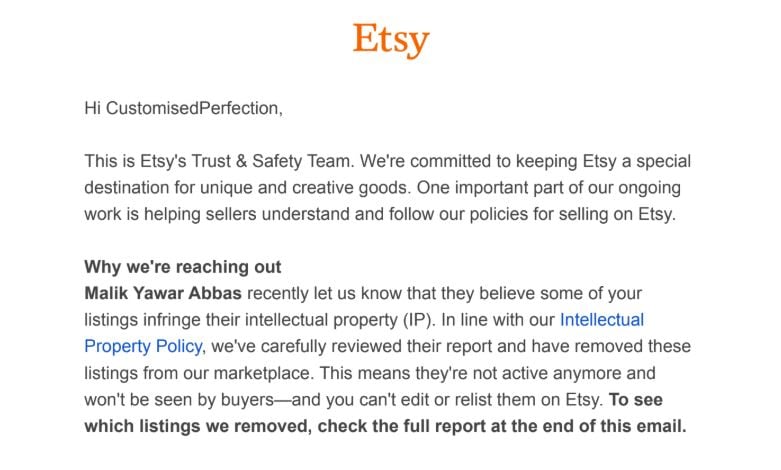
The communication from Etsy indicated that the trademark infringement was reported by Malik Yawar Abbas, a Canadian trademark holder for the term “bruh.”
Karam is among several Etsy sellers who shared with CBC News their experiences of having their products removed following reports from the trademark owner. CBC News examined several emails sent by Etsy to Karam and two other sellers, revealing that the takedowns were triggered by complaints from Abbas.
Karam alleges that Abbas is “squatting” on the trademark, seeking to profit by licensing the term to others instead of creating his own products. Legal experts suggest that it is the responsibility of online platforms and the judicial system to mitigate such misuse of trademarks.
No clothing available, request for payment
The Canadian Intellectual Property Office (CIPO) issued a trademark for the term “bruh” in July 2025 for various clothing items, as indicated by the government’s trademark database. A different trademark for the same term was recently awarded to Abbas for its use in advertising restaurant services.
In a response to CBC News, CIPO did not address inquiries about the “bruh” trademark but stated that each trademark application is “examined on a case-by-case basis.”
After his products were removed, Karam discovered the trademark holder’s website and was astonished to find a section outlining how he protects the “bruh” trademark and encouraging others to license it for permission to use the term.
“We didn’t create the word. The streets did. The internet did. But we recognized its significance,” the website states.
The site does not sell clothing; it only displays mock-ups of apparel and products, such as energy drinks, that utilize the term “bruh.”
In an email to CBC News, Abbas explained that these images are intended to illustrate “potential commercial applications” of the brand.
When Karam reached out to Abbas regarding the Etsy removals, asking if he would retract his complaint, Abbas stated that he would if Karam agreed to several conditions and paid him $1,000.
Karam declined the offer, asserting that the circumstances indicate “trademark squatting.”
“It’s incredibly disheartening,” Karam remarked. “When someone immediately demands $1,000 just to retract their complaint, it’s clear they are acting in bad faith. That’s my personal conviction.”
Abbas informed CBC News via email that the $1,000 was a suggested settlement as part of a negotiated resolution concerning a disputed trademark issue. He clarified that no payment was made, and no financial settlement was reached.
He also disagreed with the characterization that he is squatting on the trademark.
“BRUH is a legally registered Canadian trademark being developed as a commercial licensing brand,” Abbas asserted.
He has since withdrawn the complaint to Etsy, stating that he did so after the removal of the 11 designs, which were no longer being sold to Canadian consumers.
However, Karam insists that “the harm has already occurred.”
He is currently consulting with an intellectual property attorney and is contemplating taking legal action to challenge the trademark on grounds of bad faith.

Trademarks filed in bad faith can be challenged
According to a relatively recent addition to Canada’s trademark laws introduced in 2019, a trademark can be rendered invalid if it was registered in “bad faith,” as explained by Carys Craig, a professor at York University’s Osgoode Hall Law School with expertise in intellectual property law.
Although cases claiming bad faith have surfaced, she notes that this aspect of the law remains largely untested, leaving uncertainty about how a court might rule in this particular situation.
Craig mentions that licensing can be a legitimate method of utilizing a trademark. Overall, she suggests that the manner in which the “bruh” trademark is presented on the website, along with the requests for takedown orders, could potentially meet the criteria for bad faith.
“We just don’t yet know what that looks like in practice.”
Abbas told CBC News that he trademarked the term to create a “licensing-only brand at a time when there was no BRUH-named brand in Canada,” and contends that “protecting, enforcing, or commercially developing” the brand should not be seen as acting in bad faith.
“If there is a legitimate dispute regarding the validity, scope, or infringement of the registration, Canadian law offers channels and forums to resolve those matters,” he stated.
Does a trademark grant ownership of a word?
Even though widely used, common terms and pop culture expressions can be trademarked; the context is crucial, according to Craig.
The core function of a trademark is to distinguish the products or services of one brand from those of another, she explains. For example, the word “apple” cannot be trademarked for selling fruit since it merely describes the product, yet it can be trademarked for selling computers.
While there are additional factors assessed during a trademark application, Craig indicates that since “bruh” does not describe the product in this instance, it could reasonably serve as a trademark.

However, trademarking a term does not equate to outright ownership, and experts assert that the “bruh” apparel on Etsy may not necessarily infringe simply because it features the word.
Paula Clancy, a partner specializing in intellectual property law at Gowling WLG, explained that to assess whether infringement occurred, courts would consider how the alleged infringer used the trademark—either as an indication of origin, to imply association with a specific brand, or in a decorative manner as part of a design.
T-shirts with phrases such as “Bruh, we back,” which Karam had removed, “might indeed fall within those exceptions,” Clancy noted, suggesting they might not constitute an infringement.
Despite this, Karam claims that Etsy did not provide him with an opportunity to contest its decision to remove the items.
For his part, Abbas stated that he reported listings to Etsy when he “reasonably believed” they may violate his trademark rights, and he never intended to “hinder individuals from using the word in everyday conversation or communication.”
An Etsy representative stated in an email to CBC News that the platform evaluates and removes items when appropriate notifications of infringement are received and emphasized that sellers must adhere to all legal regulations and site policies. The spokesperson advised sellers to contact the individual who submitted the original complaint if they believe their listing should not have been taken down.
Clancy expressed understanding of why marketplaces like Etsy take trademark infringement reports seriously, but she noted that a policy lacking an appeals process poses a challenge for sellers who may not wish to incur the costs of legal proceedings.
Testing the limits of the trademark system
According to Clancy, instances like this are uncommon in Canada.
“Typically, we observe the opposite scenario, where infringers use trademarks without authorization,” she remarked, adding that some individuals attempt to leverage the reputation of established brands.

However, Craig expresses concern that due to the high costs associated with trademark disputes, particularly for small businesses, cases of trademark squatting or excessive enforcement may go unnoticed more frequently than one might think.
She also highlights that despite pushback from Etsy sellers, the trademark holder in this situation has treaded a “delicate line” that could still be seen as lawful, given that they were granted trademark rights and licensing trademarks is permissible.
“This scenario is really pushing the boundaries of the trademark system and taking advantage of some of the … policy vulnerabilities or loopholes within the framework,” Craig stated.
She suggests that stricter regulations may be necessary to avert such situations. Enhanced scrutiny during the initial trademark registration process may be required, especially for trendy phrases that could attract attempts to monopolize them.
Creating simpler methods for disputing potentially bad-faith trademarks and changes to online marketplaces that permit sellers to appeal takedown actions could also prove beneficial, according to Craig.
She described it as a “worst-case scenario” to find oneself in a situation where everything is protected, nothing is litigated, and “all items are removed as soon as a trademark holder asserts their rights.”