


On Wednesday, Google introduced a new feature in Canada that enables users to make purchases through an AI chatbot, effectively removing the need for a traditional e-commerce checkout cart.
This tool, known as the Universal Commerce Protocol (UCP), was made available to American users starting October 15.
This latest offering from the California-based tech giant is part of a competitive effort to dominate the e-commerce landscape, as various technology firms strive to integrate conversational AI as digital sales points.
While major retailers like Amazon and Walmart have deployed AI assistants limited to their platforms, Google is up against versatile agents like Meta’s Muse, which can function across various websites.
Both Meta and Alphabet are aiming to establish themselves as the universal checkout solution for online businesses, designed to simplify the shopping experience by minimizing the need for customers to re-enter payment information across different sites.
As of Wednesday, consumers can purchase items found via Google Search by interacting with its Gemini chatbot. Transactions will be processed through Google Pay, utilizing shipping and payment information saved in Google Wallet. The seller of record remains the individual retailer, not Google, which assumes full legal responsibility for order fulfillment.
Eric Morris, who oversees retail operations at Google Canada, describes the new feature as “a new way for Canadians to shop.”

As privacy fears and security concerns rise, some of Canada’s biggest banks are hitting the brakes on clients using personal AI agents — with most outright banning them.
Currently, Google’s service is available through a select group of Canadian retail partners, including Lululemon, Shoppers Drug Mart, Simons, and various Shopify merchants, with expectations for more partnerships in the upcoming year.
Shopify serves as both a collaborator and competitor to Google. The Ottawa-based firm contributed to the development of Google’s in-chat checkout while simultaneously launching its own competing AI shopping solutions.
According to Morris, “AI is changing the way that consumers search.”
Google, primarily recognized for its search engine, is particularly vulnerable to these shifts. Just last Thursday, Alphabet’s shares fell sharply, losing approximately $500 billion US in market capitalization in a single day, following disappointing search and advertising revenue results.
“In the past, you might search for running tights on Google and receive ten blue links along with images of various products,” Morris explained, reflecting on the traditional search experience.
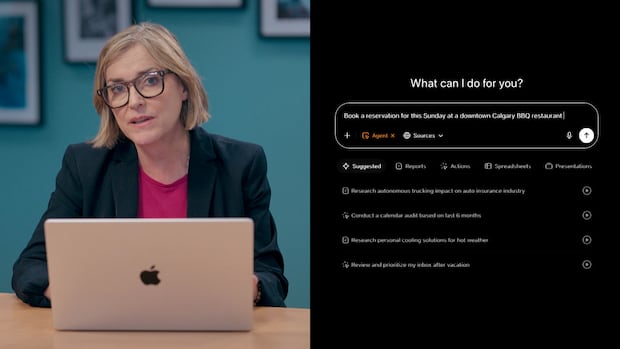
OpenAI and other major tech firms are beginning to roll out the next generation of artificial intelligence, designed for greater autonomy. CBC’s Nora Young discusses how agentic AI functions and why it may change internet usage.
Shopping using AI is notably more conversational, he asserts. For example, a user might ask, “What are the best running tights for a frigid, snowy winter in Toronto?”
“Within that chat interface, you would see a variety of options and products tailored to your inquiry, supported by our predictive capabilities regarding which items are most likely to suit your needs,” he elaborated.
He also pointed out that retailers will have free access to Google’s UCP service.
Choices ‘more constrained’ with AI shopping
A prominent Canadian policy expert argues that this new shopping method grants companies like Google and Meta access to transaction and purchase data that would typically remain with individual retailers.
Vass Bednar, managing director at the Canadian SHIELD Institute for Public Policy, raises concerns over whether AI can genuinely prioritize consumer needs, such as identifying the best price.
“Research is beginning to indicate that consumer choice in an AI shopping framework tends to be more limited than that available on the open web,” she stated.
“The potential risk or compromise is that you might not actually receive the best quality or lowest price. Instead, you may be presented with an offer influenced by an advertising relationship.”

Matt Robb began using Muse, Meta’s AI agent, for Facebook Marketplace transactions. However, after listing a keyboard for sale, he encountered unexpected complications. An expert advises people to carefully consider what they allow Muse to access.
Nonetheless, a spokesperson from the Retail Council of Canada mentioned that this feature could help cost-conscious shoppers find discounts and compare prices more effectively.
“I view this as a positive development, as it helps consumers feel better prepared,” noted Santo Ligotti, the council’s vice-president of membership and marketing.
“There will always be concerns about inaccurate information, particularly if it is sponsored or biased… but as Canadians become more accustomed to it, and as companies increase their visibility on AI platforms, I believe it will be seen as another useful tool for planning spending.”
However, despite the potential for AI agents to expedite the search for products, users should not assume they are always receiving the best prices, cautioned David Soberman, a marketing professor at the University of Toronto’s Rotman School of Management.
“I strongly recommend that individuals do their own cross-checking, as these AI agents sometimes overlook options.”
Retailers becoming ‘passive players,’ says U of T prof
Similar to Bednar, Soberman believes that more control is being transferred to major tech companies.
“The combination of a search engine with AI agents has rendered retailers more passive participants in this ecosystem,” he remarked.
Google Canada anticipates that 59 percent of Canadians will utilize an AI tool for their holiday shopping this year. In contrast, predictions from Deloitte and PwC are lower, estimating 39 percent and 28 percent, respectively.
Recently, several of Canada’s largest banks announced their intentions to restrict third-party AI agents from accessing clients’ online banking accounts and other sensitive information, citing concerns over safety and security.

Morris reassures that Google is not concerned.
“Ultimately, it’s humans making the purchases. No one else,” he stated. “The transactions are secure and encrypted. You will make purchases safely using Google Pay.”
Meanwhile, Nick Engel, Lululemon’s senior vice-president of global digital experience, anticipates that agentic AI shopping will resonate with fans of the Vancouver-based activewear company.
“I expect to see a surge of customers utilizing [large language models] for both product discovery and shopping during this holiday season,” he noted.
“Financial institutions will undoubtedly maintain different standards compared to retailers.”