

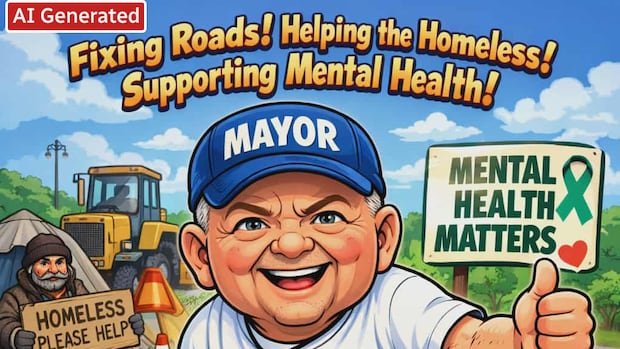

Bob Johnston, a mayoral candidate in Sudbury, Ontario, is utilizing artificial intelligence to create campaign posters, aiming to infuse humor and optimism into his community. The AI-generated images depict Johnston as a cheerful cartoon character, prominently featuring his prosthetic legs. One poster showcases him filling a pothole, while another portrays him driving past the iconic Big Nickel in a van.
Johnston expressed delight in the positive reception of his AI campaign posters, noting that individuals have found them amusing, with one person even requesting to keep a sign for their garage post-election. While candidates in Ontario are undergoing certification for the upcoming municipal elections in October, experts caution that there are currently no specific regulations governing the use of AI in advertising campaigns.
According to Andrea Lawlor, an associate professor in McMaster University’s political science department, AI can serve as a valuable resource for political contenders, especially for those lacking substantial financial support, enabling cost reduction in campaign activities. However, Lawlor highlighted the lack of comprehensive governance in the realm of AI usage, emphasizing the need for regulatory frameworks to address the evolving landscape.
Regarding existing regulations, the City of Greater Sudbury confirmed that there are no explicit rules within the Municipal Elections Act or local bylaws that specifically address or prohibit the deployment of artificial intelligence in municipal election advertising. While the utilization of AI in ads is generally permissible, election law expert Scott Lemke emphasized the criminal prohibition against employing AI to create misleading “deepfakes.”
Professor Lawlor underscored the ongoing discussions around AI regulation, citing recent legislative developments such as Bill C-25 amending the Canada Elections Act. Despite some progress, Lawlor noted the persistent gaps in enforcing prohibitions and regulations surrounding AI usage in political campaigns, urging expedited governmental actions to address public concerns and ensure transparency.
In response to growing apprehension among Sudbury residents regarding AI-generated content in political ads, concerns were raised about the potential impact on younger generations’ perception of truth and falsehood. While some residents expressed reservations, Johnston defended his innovative approach, receiving positive feedback on his AI-generated signs, which he views as a symbol of change and progress in the city.
Lawlor cautioned about the uncertainty surrounding AI utilization in political campaigns, warning of a potential “Wild West” scenario in the absence of clear regulations. She emphasized the importance of maintaining verifiability standards in political advertising and suggested the incorporation of disclosure statements on AI-generated content to enhance transparency.
As the debate on AI regulation continues, Johnston acknowledged the novelty of his AI campaign posters and expressed willingness to adapt to future requirements. While acknowledging the evolving landscape of AI in political advertising, Johnston emphasized his pride in being an early adopter of AI technology for campaign purposes, emphasizing the need for proactive changes to reflect a positive vision for the city.